
Measure a tee you already own across the chest, flat, from armpit seam to armpit seam, then double that number to compare it against a size chart’s body-fit range. If the result falls between two sizes, size up for anything relaxed or 100% cotton that hasn’t been pre-shrunk, and size down only if you’re chasing a fitted look.
TL;DR:
- Choose a shirt size by measuring a well-fitting tee flat across the chest and doubling that measurement to match your body circumference.
- Most brands increase garment width by about 2 inches per size, meaning a size medium with a 20-inch chest width fits a 38-41 inch chest range.
- Fit type significantly affects sizing; slim fit is closer to body measurements, while relaxed or oversized fits require sizing up for comfort or volume.
- For untreated 100% cotton shirts, plan to size up one to offset 3 to 5% shrinkage after hot washing and drying.
- Always compare actual garment measurements on product pages against your own measured tee for the best fit, rather than relying solely on letter sizes.
Table of Contents
- What Does a Standard T-Shirt Size Chart Look Like?
- How Do You Measure a T-Shirt and Your Body?
- Garment vs Body Measurements: What “Fits Chest” Really Means
- Which Fit Type Should You Order?
- Will Your T-Shirt Shrink? Fabric Guidance to Know Before Ordering
- How Do You Choose Between Two Sizes?
- How Does Cloudy Wingz Handle Sizing?
- Why Measuring Beats Guessing Every Time
- Start With a Tee Built on Real Garment Measurements
- Sources
- FAQ
What Does a Standard T-Shirt Size Chart Look Like?
A t-shirt sizing chart typically lists three numbers per size: garment chest width (measured flat), body length, and the “fits chest” range that tells you what body circumference the shirt is built for. Garment chest width is the flat measurement across the shirt from one armpit seam to the other. Double it, and you get the approximate body circumference the shirt is designed to cover, since the fabric wraps all the way around you, not just across the front.
Most brands step sizes up by about 2 inches of garment width per size, which is why a jump from Medium to Large often feels bigger than you’d expect just from the letter change. A size chart from Wearlie shows a typical unisex range running from around 16.5 inches of garment width at XS to about 32 inches at 5XL.
| Size | Garment Chest Width (in) | Body Length (in) | Fits Chest (in) |
|---|---|---|---|
| XS | 16.5 | 31 | 31–34 |
| S | 18 | 27 | 34–37 |
| M | 20 | 28 | 38–41 |
| L | 22 | 29 | 42–45 |
| XL | 24 | 30 | 46–49 |
| 2XL | 31 | 31 | 50–53 |
| 3XL | 28 | 32 | 54–57 |
| 4XL | 30 | 33 | 58–61 |
| 5XL | 32 | 34 | 62–65 |
Read this table with the flat measurement in mind: the garment chest width column is what you get from a tape measure laid across a shirt on a table, not around your torso. The “fits chest” column already accounts for doubling and a bit of breathing room, so that’s the number to match against your actual body measurement.
How Do You Measure a T-Shirt and Your Body?
Getting an accurate size starts with two separate measurements, and mixing them up is the single most common way people order the wrong tee.
- Lay a shirt you already like flat on a table or bed, smoothed out with no wrinkles or folds.
- Measure straight across from one armpit seam to the other. This is your garment chest width.
- Double that number. A 20 inch flat measurement becomes roughly a 40 inch body circumference.
- Measure the body length separately, from the highest point of the shoulder seam straight down to the hem.
- For your own body, wrap a tape measure around the fullest part of your chest, under your arms and across your shoulder blades, keeping the tape level and snug but not tight.
- If you don’t have a tape measure, a piece of string works: wrap it around your chest, mark where it overlaps, then lay it flat against a ruler.
The most common mistake is measuring a shirt around its full circumference instead of flat across one side, which doubles the number by accident and throws off every size comparison after it. The step-by-step measuring guide from Arklavo recommends taking chest width about an inch below the sleeve seam for the most consistent reading across different shirts.
Garment vs Body Measurements: What “Fits Chest” Really Means
Garment chest width and body chest circumference are not the same number, and confusing them is why so many online orders come back wrong. Chest width is the flat, one-side measurement you take with the shirt laid out. Body circumference is the full wraparound measurement of an actual chest. To go from one to the other, you double the flat number, then account for ease, the extra room built into a shirt so it doesn’t feel like shrink wrap.
- Garment chest width (flat): one side of the shirt, armpit to armpit.
- Doubled garment width: the shirt’s total circumference around a body.
- Ease allowance: typically 2 to 4 inches of extra room built into that circumference.
- Fits chest range: the body sizes the shirt is designed to comfortably cover.
Statistic: A garment chest width of about 20 inches doubles to roughly 40 inches of shirt circumference, which MFG Merch’s size chart maps to a body chest range of about 38 to 40 inches for a regular fit Medium. That 1 to 2 inch gap between the doubled garment number and the stated body range is the ease allowance at work.
Which Fit Type Should You Order?
Fit type changes how much ease is built in, and it should shift the size you actually pick, not just the vibe of the shirt.
- Slim fit trims the ease down close to your actual measurements, so many people order their true size or even a hair smaller.
- Regular fit carries the standard ease allowance described above, which is what most size charts are built around.
- Relaxed fit adds extra room through the body, so ordering true to your chest measurement often still results in a looser drape than a regular cut.
- Oversized fit is designed to be worn a size or two larger than usual, so sizing up on purpose is the intended result, not a mistake.
Unisex sizing is cut on a men’s block, which runs roomier through the shoulders and body than most women’s specific cuts. Because of that, women ordering a unisex tee often size down one to two sizes from what they’d normally wear in a women’s fit, according to sizing guidance from T-Shirt Elephant.
Pro Tip: If you’re layering a tee under a hoodie or jacket, size up one from your usual fit so the shirt doesn’t pull tight across the shoulders when you move.
Will Your T-Shirt Shrink? Fabric Guidance to Know Before Ordering
Fabric content changes how much a shirt shrinks after its first wash, and that shrinkage can be enough to knock a true fit into a tight one.
- 100% cotton that hasn’t been pre-shrunk can shrink 3 to 5% after the first hot wash and tumble dry.
- Pre-shrunk cotton typically shrinks closer to 2 to 3%, since most of the fiber relaxation already happened at the factory.
- Cotton-poly blends usually shrink only 1 to 2%.
- Full polyester shrinks less than 1% in most cases.
Statistic: That 3 to 5% shrinkage range for untreated 100% cotton, reported by T-Shirt Elephant, is enough to turn a snug Medium into a genuinely tight shirt after a few hot washes.
How Do You Choose Between Two Sizes?
When your measurements land right between two sizes on the chart, a few simple rules make the decision faster than staring at the numbers.
- Going for a relaxed or oversized look: size up, or size up two if you want a noticeably baggy silhouette.
- Want a fitted, tailored look: order your true size, and only size down if the brand explicitly runs large.
- Planning to layer over the tee: size up one to leave room for movement.
- Ordering 100% cotton that isn’t pre-shrunk and washing hot: size up to offset shrinkage.
Ordering for a group, like a team or event? A common starting ratio per 10 shirts is 1 Small, 2 Medium, 3 Large, 3 XL, and 1 2XL, adjusted based on who’s actually wearing them, per sizing data from T-Shirt Elephant.
- Measure a tee you already own and love the fit of, using the flat method above.
- Check whether the product you’re eyeing is labeled slim, regular, relaxed, or oversized.
- Confirm the garment measurements listed on the actual product page match your numbers, since letter sizes vary by brand.
How Does Cloudy Wingz Handle Sizing?
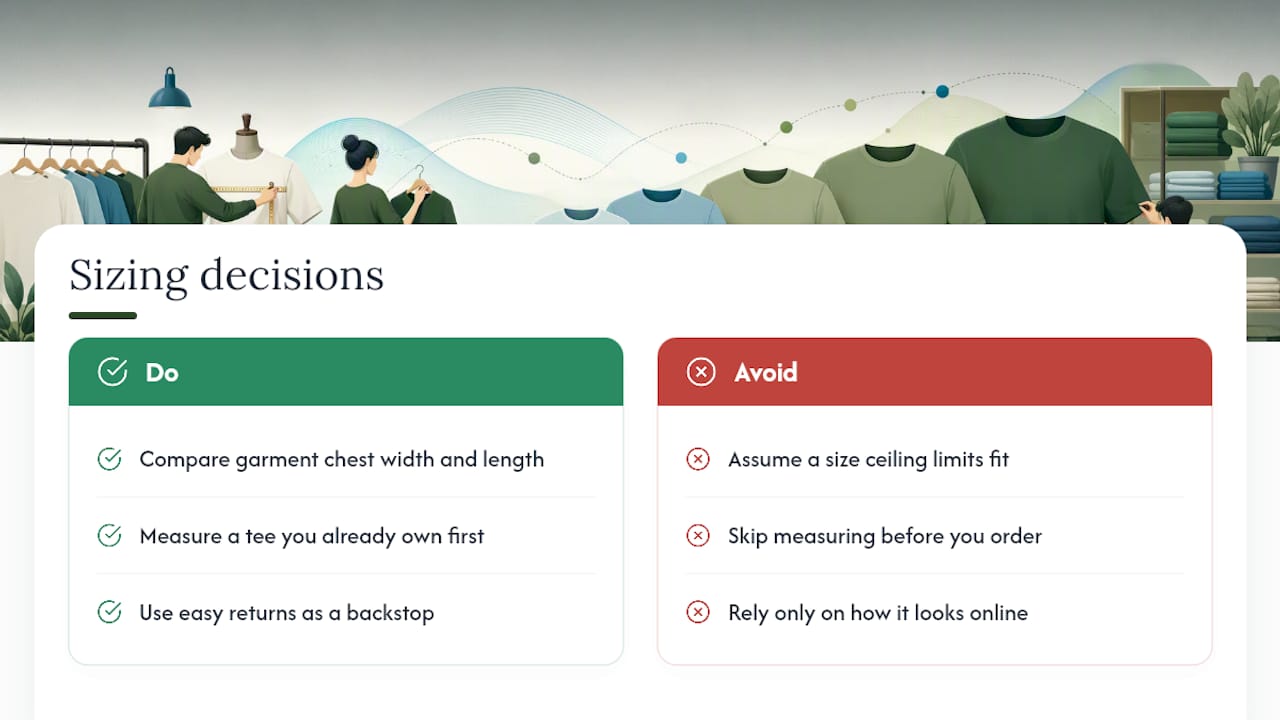
Heavyweight tees are typically offered in a wide size range and in different cuts, so the fit decision comes down to the look you want, not a size ceiling. Product pages commonly include garment chest width and body length, allowing you to compare measurements of a tee you own with those listed before ordering.
Sizing mistakes can happen, so policies like easy returns and free shipping on orders over a certain amount help as a backstop. Measuring first cuts down the odds you’ll need either one.
Why Measuring Beats Guessing Every Time
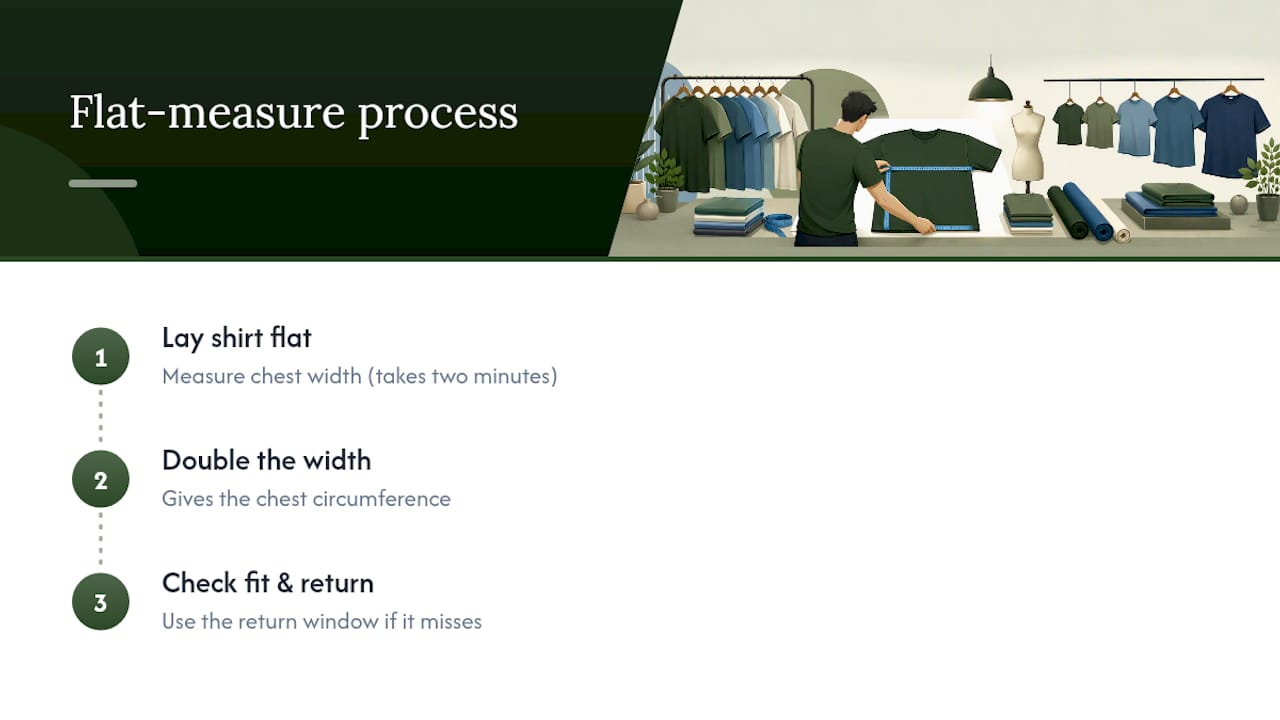
A letter size on a tag tells you almost nothing on its own. Two shirts labeled Large from two different brands can differ by two full inches of chest width, which is exactly why the flat-shirt measuring method matters more than the size printed on the label. It takes two minutes and removes the guesswork that letter sizes almost guarantee.
Check the garment measurements on any product page before you buy, and if the fit still misses once the shirt arrives, use the return window rather than living with a shirt that pulls or swims. That’s the whole system.
— Cloudy
Start With a Tee Built on Real Garment Measurements
Some brands publish garment chest width and body length on product pages, so you can run the flat-shirt method above and check your numbers before you order. That’s a real edge over shopping a size chart alone: you’re comparing your actual tee measurements against the actual shirt you’re about to buy, not a generic letter label.
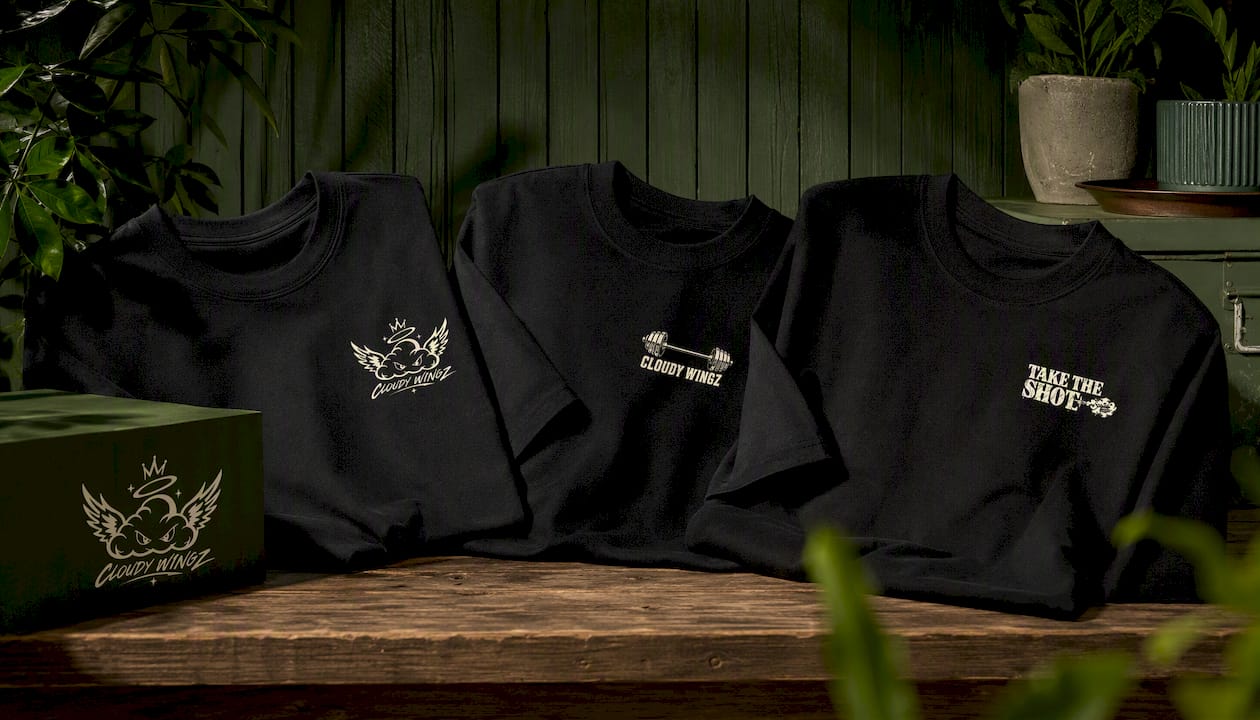
The Cloudy Wingz Other SIde Max Heavyweight Tee and the 1000LB Club Regular Fit tee both list full garment measurements alongside their S–5XL range, and the Full Clip Regular Fit tee from House of Clouds follows the same approach. Browse the full Tees collection if you want to compare a few heavyweight cuts side by side, and check the Hoodies, Sweats, Hats, Ladies, Active, or Youth lines if you’re outfitting more than yourself. Grab a shirt you already own, measure it flat, hold that number against the product page, and order with actual numbers instead of a guess. Free shipping and easy returns may be available to help if the fit needs adjusting.
Sources
For raw size tables and more measuring detail, see Wearlie’s size chart, MFG Merch’s chart breakdown, T-Shirt Elephant’s sizing guide, CoreClassic’s measurement guide, and Arklavo’s step-by-step guide.
- T-Shirt Size Chart: US, UK and conversions — Wearlie
- T-shirt Size Chart - MFG Merch
- T-Shirt Size Chart 2026: Men, Women, Youth Sizing Guide — T-Shirt Elephant
- How to Measure Shirt Size (Step-by-Step Guide) – Arklavo
FAQ
How Do I Find My T-Shirt Size?
Measure a shirt you already own flat, from armpit seam to armpit seam, then double that number to get an approximate body circumference. Compare that figure against the “fits chest” column on a size chart to land on your letter size.
What Are Standard T-Shirt Sizes?
Standard unisex sizing typically runs XS through 5XL, with garment chest width increasing by about 2 inches per size, according to MFG Merch’s sizing data. Cloudywingz offers this full S–5XL range across its heavyweight tee lines.
Is a Size 40 Shirt Medium or Large?
A 40 inch chest measurement typically falls right at the top of a Medium or the low end of a Large, depending on the brand’s specific chart. Check the actual garment measurements on the product page rather than relying on the letter alone, since sizing varies between brands.
What Size Fits a 17, 34/35 Shirt Measurement?
That notation refers to dress shirt sizing, which is based on neck circumference and sleeve length. T-shirt sizing uses chest width measurements and does not follow that system.
How Much Should I Size Up for Shrinkage?
If you’re wearing 100% cotton that isn’t pre-shrunk and plan to wash hot and dry on high heat, size up one to offset the 3 to 5% shrinkage that fabric typically sees, per T-Shirt Elephant’s guidance. Pre-shrunk cotton and blends shrink less, so sizing true is usually safe with those fabrics.